

Tips in healing Stiff or Injured Neck
- Sep 9, 2016
- 5 min read
As a licensed practitioner, I have been trained in numerous treatments and protocols to help this condition. Besides that, being an active practitioner, I need to find ways to solve my own injuries. You can find various methods online (Epsom salt bath, hot oil massage etc)Thus, I compiled the various methods I've practiced and get the easiest way to relieve your neck discomfort on your own. Below are the technique I personally practice and does not require any special knowledge or training to do. These therapeutic techniques are intended to be used after the acute-phase of the injury(4-5 days after the injury).
After a neck strain/sprain, the muscles in the neck will often become tight, guarding the affected area and limiting motion and mobility. Anything that can be done to safely alleviate muscle tension, improve range of motion, and promote blood circulation to the affected area, is going to help the healing process.
Methods
(1) Stretching Exercises
The levator scapular muscle is one little nasty muscle that may cause us problems from time to time, especially for those who spend a lot of time at a desk, looking down at their tablets or phones, or laying on pillows that are too high for their bodies – just to name a few common activities.
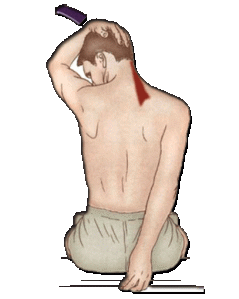
Every time we raise our shoulders, we engage the levator scapula muscle. Most of us spend hours every day with this muscle engaged, then wonder why our neck and shoulders are so tight!
Manipulation Methods: (if you pain is at the right, move the head to the left vice versa
Reach your right hand behind your back and toward your left hip or grip against the chair
With your chin dropped toward your chest, tip the left ear toward the left shoulder and rotate your head to the left. Your nose should be pointing toward your left armpit.
To further the stretch, bring your left arm up and over your head. Grasp the right side of your head and gently pull it toward your left shoulder, without forcing. It should look like you are sniffing your armpit!
Breathe fully, deeply and slowly. As you feel the muscle relax you will notice your head moves more fully into the stretch position. Allow this to happen. Hold for at least 30 seconds. Repeat on the other side.
Such exercise can be done from time to time whenever you are sitting to long at work or at school.
(2) Manual Cervical Traction (credits to breakingmuscle.com for the article)
Tight muscles will constrict and compress everything around them. The idea behind using traction is to create more space and alleviate pressure by improving the blood supply to the neck muscles, tendons, and ligaments of the affected area.

Manipulation Methods:
Gently roll and massage the muscle around the neck to first relieve the tension of the muscles.
Then get a friend for a help. Lie down on your back and place a folded (lengthwise) hand towel under the occiput of your head. This is the rear part of your skull that rounds out away from your neck.
Traction is applied by having a friend gently pull the towel straight towards them (the head is moved to maximize relaxation and comfort). Try to get them to hold the position for at least 3 minutes.
Repeat the exercise 2-3 times per-day or until you feel some relief.
(3)Acupoint massage for the neck
Luo Zhen落枕 - it is the point used to relieve stiff neck especially when its due to poor posture at sleep. It can be used during the acute phase of neck stiffness the moment you wake up with a discomfort neck pain. REMEMBER Prompt treatment facilitate recovery. Apply the pressure on the point to ease the pain. The point is located in the depression between the two bones near the knuckles of the middle and pointer fingers.

Manipulation Methods:
If your neck is stiff on the right side, then massage the point on your left hand, and if your neck is stiff on the left side, then massage the point on your right side. Massage this point by applying light pressure into it with your fingertip.
Maintain the pressure for a couple of minutes. Tenderness of the point should be felt.
In the meantime, exercise your neck by rotating your head side to side.
You should slowly begin to notice a slight increase in your range of motion while experiencing a decrease in pain.
So, if bad posture, too much time in front of the laptop, or just a night with a bad sleeping position gives you a neck that just won’t move, no harm trying this.
(4) Trigger Point Stimulation
Your shoulders ache, your neck hurts and it is often deep and achy. You may have a headache, especially in the temples or behind your eyes or at the base of your skull. You may feel burning between your shoulder blades after sitting at your computer without elbow support. Then consider this ~ The trapezius muscle!
Manipulation Methods:
Get a wall and a tennis ball. (it can also be any other ball, or round durable item).
Massage yourself by rolling the ball on your traps, with some pressure. You will feel how tight it is and there will likely be one spot that hurts the most. Wherever that spot is, stay there with your tennis ball and slightly push. Hold that for at least 90 seconds or until you feel a release of tension. Repeat this until you feel that they have gotten looser. Keep looking for the tightness and repeat the step until the tension is released.
Since massages are also helping to release toxins back into the blood stream, be sure to drink plenty of water after.

You can now see why I believe every trigger point therapist, whether they are professional or layman practitioners, should be experts on the trigger points in the trapezius muscle; they are involved with too many myofascial pain disorders to not take seriously.
(5) Sleep well
Getting enough sounds sleep will definitely facilitate the healing. Make sure your mattress is firm enough to provide support for your spine and neck. Get a good pillow just a good height for your head.
(6) must DO EXERCISE everyday : 'Training' your CHEST muscles
With the current technology era, we tend to get a elongated neck and shoulder muscles(upper back muscles) while using the computers, ipad, phones etc. As our back muscles are pulled, it makes our front muscle -chest muscles to be lazy and weak. In a long run, we get round shoulders, hunch back posture, turtle neck posture - signs that leads to chronic neck and shoulder pain. Thus, it is so important to get your lazy muscles at work to balance up your front and back muscles to ensure a good posture and no pain working days.


Manipulation methods (As above) :
1. Lie sideways on a hard ground with your knees flex at 90degree, place a small pillow or a rolled towel against your knees to fix your posture.
2. Straighten your trunk with arms interlocking on the back of the head.
3. With coordination of breathing, the chest is open up (arm moving to the opposite of the body) when you breathe out, close the chest when you breathe in.
4. Repeat the actions 15 to 20 times SLOWLY with steady breathing.
5. Then repeat the exercise for the opposite of the chest.
With daily hard work on the chest exercise, it has proven to show good results in people with chronic repetitive neck and shoulder tightness. Beside that, it is definitely a good exercise to improve your poor posture.
Lastly, Try slow and steady swimming - that's definitely a way to get a good overall relax muscles =)
Good Luck !


Comments